
Private shops appointment still available. Drink better! Reach out for one-on-one curation time with me with no commitment or minimum purchase required.
Subscribing is a way to show your appreciation for:
my wine recommendations,
any assistance I provide along your wine journey, or
my writing entertainment!
Some of you likely sensed that I would write about Champagne soon.
There was some foreshadowing when you touched on Dom Pérignon and Benedictine monks. (see links at bottom of this article)
Awesome, I love that you are paying attention!
Indeed, Dom Pérignon was part of the Benedictine Abbey of St. Pierre d’Hautvillers, which some consider as the birthplace of Champagne, the sparkling wine. There are many myths that revolve around Dom Pérignon, including that he was the ‘inventor’ of sparkling Champagne.
This is false as no one person ‘invented’ Champagne. Ultimately, there was an evolution of Champagne spanning from approximately the 1600s to 1800s.
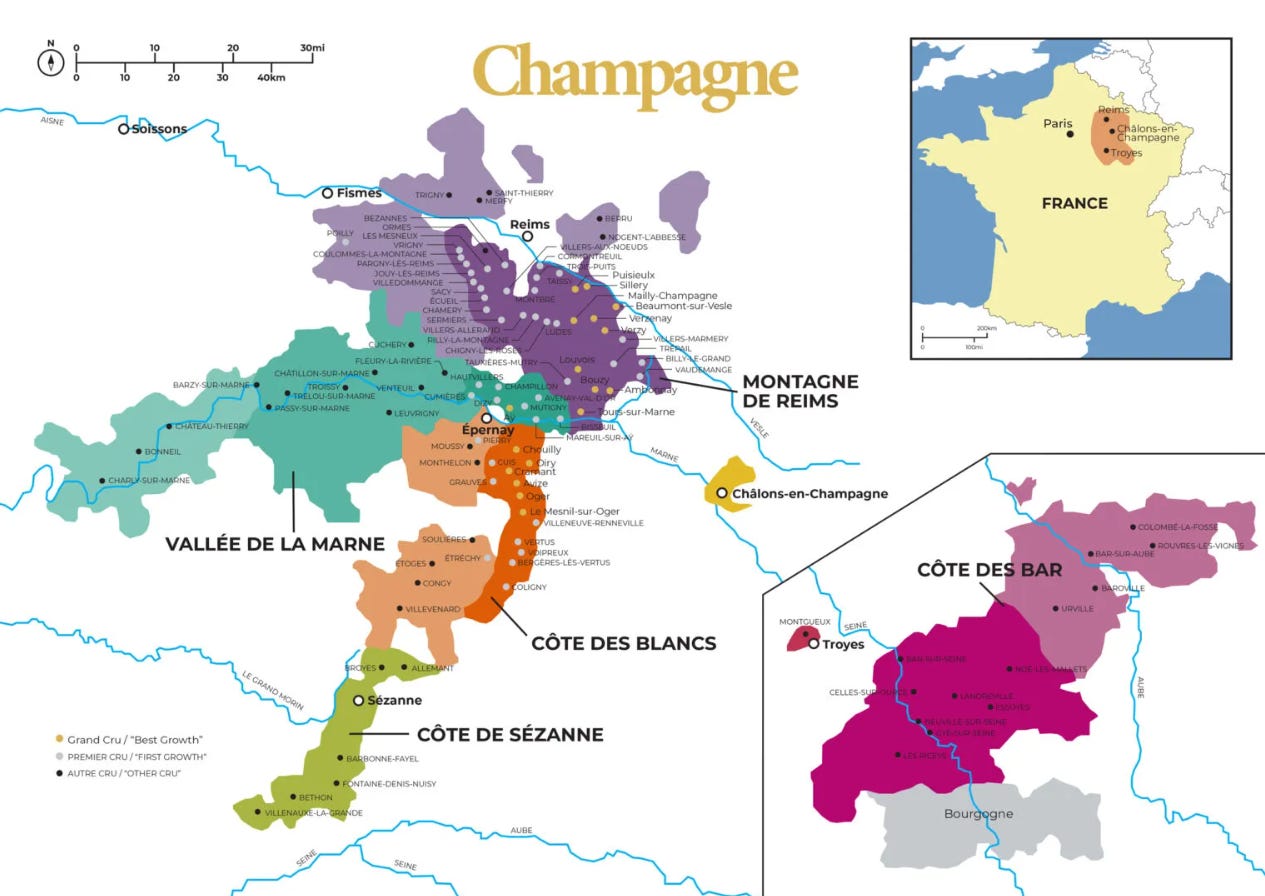
But first, let’s situate ourselves in the wine region of Champagne in northern France, quite close to Paris.
Hot tip: this proximity makes it a great first night stop to recover from jetlag should you be coming from overseas.
The Abbey where Pérignon spent over 40 years of his life was in Hautvillers, a village north of the city of Épernay. Épernay and Reims, the capital, are the key urban centres for the Champagne region.
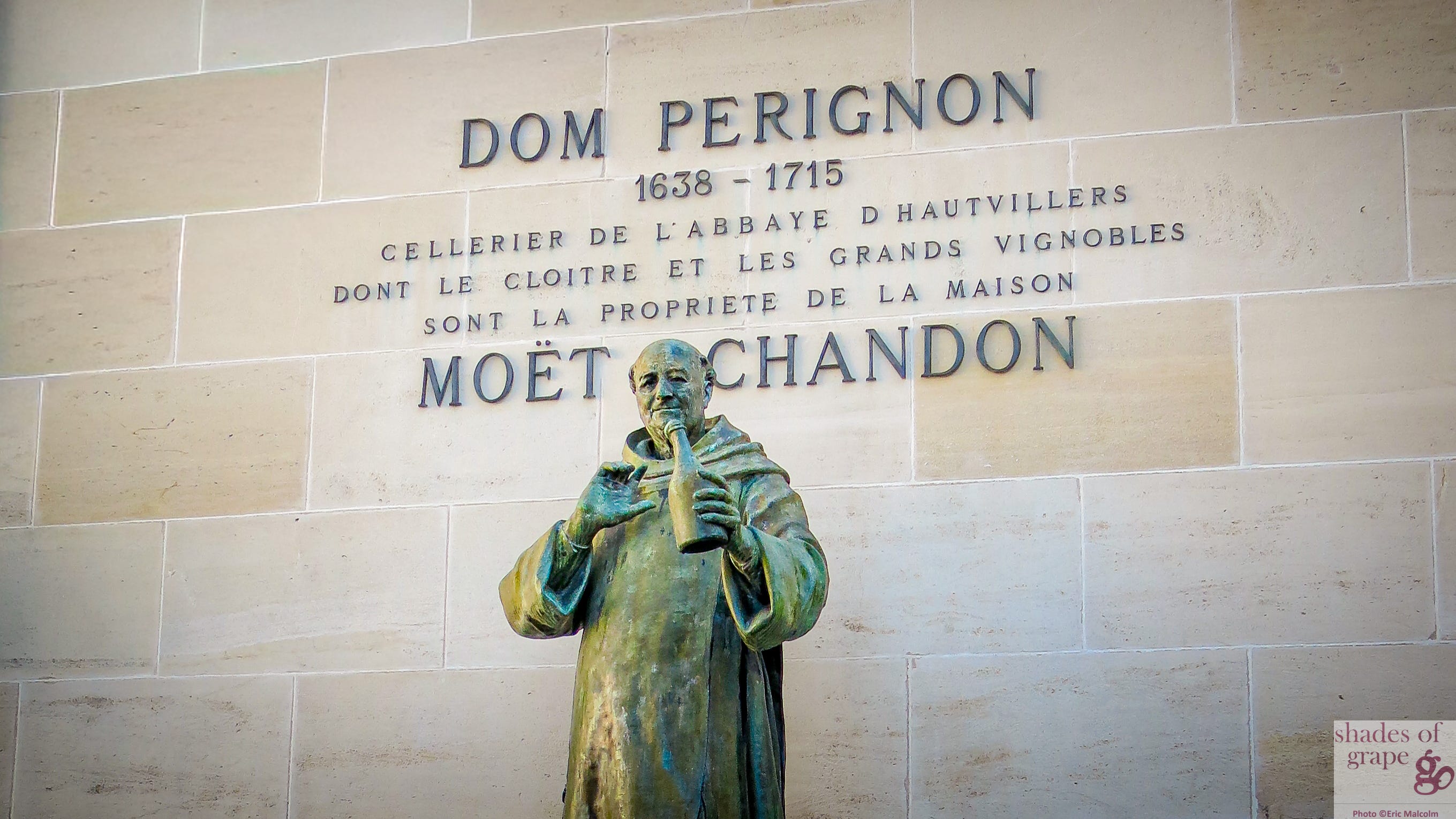
The evolution of sparkling Champagne started in the Champagne region in the 17th century. Dom Pierre Pérignon (1638 -1715) joined the abbey in 1668, becoming the abbey’s cellar master.
At that time Champagne was a still, pink wine made from Pinot Noir.
But Pinot Noir is a black grape, and doesn’t still mean no sparkles?
Correct on both counts. The pink comes from the fact that some of the skin’s colour leaked into the wine.
“Feels” wrong that a Champagne would not have bubbles.
Remember, Champagne is a region first, where even today still wines continue to be produced. You just don’t hear much about them on the export market.
Huh, you don’t say! So is this what you mean about the evolution of Champagne?
Yes.
But early on, the still wine was sometimes slightly fizzy. This was considered a fault by some, including by Dom Pérignon.
What was happening there?
When winter came after harvest, sometimes the fermenting wine’s temperature dropped low enough to stop fermentation. At the time we didn’t understand this magical phenomenon.
And by magical phenomenon, I assume you are referring to yeast’s role in fermentation?
Exactly. Yeast was not understood until Louis Pastor, the microbiologist and chemist, figured it out in 1860. Therefore …in the 1600s and 1700s …magic!
So, when the activity in the wine stopped, they assumed fermentation was complete. They didn’t understand that once the wine warmed up in springtime that the yeast would come out of dormancy and would get hungry again!
This meant that, depending on the stage at which the fermentation was interrupted, carbon dioxide (CO2, a by-product of fermentation) would be released into the wine and make it fizzy. If enough pressure built up when bottled in glass, the bottle would shatter, causing a mess as well as a loss of wine and revenue.
Not to mention potentially dangerous, no?
Totally, this was such a problem that in 1676 it was illegal to transport Champagne wine in glass bottles, although the monks skirted that issue with loopholes. It wasn’t until 1728 (after Pérignon’s death) that the French King Louis XV eventually allowed wines from Champagne to be shipped in glass for the first time.
So why was this an issue here and not elsewhere?
Champagne is one of the cooler climate wine regions. Other regions did not experience the same cooling in autumn, allowing fermentation to run its course naturally. This prevented the refermentation and the gas forming in the wine.
As mentioned, this fizzy wine was polarizing, but the English market started liking them. Eventually coal-fired ovens in England meant they could make stronger glass bottles. Using stronger glass bottles was something Dom Pérignon realised would solve the bursting bottles problem (mostly). This is one of the contributions he has been credited for in the evolution of Champagne.
What else did he contribute?
I mentioned the pink wine above. Depending how you press a red grape, you may or may not get as much of a pinkish hue.
Right, because a wine’s colour is dependent on the grape skin’s colour.
Exactly. So if the skin is in contact with the grape’s juice for very long, colour will be imparted into the wine. Pérignon eventually produced the first white wine made from black grapes. Today, this method is still used in Champagne and in other sparkling wine regions throughout the world.
But isn’t Champagne made with white grapes unless it is a rosé? So this is not saying much about his contributions.
Au contraire, Chardonnay, Pinot Noir, and Pinot Meunier/Meunier are all commonly used in non-rosé Champagne. So, this is very relevant!
Okay I had no idea …
Dom Pérignon was said to be a meticulous man who paid attention to details, especially when it came to improving grape growing and winemaking techniques. He strove to increase wine quality.
Tell me more.
Here are a few examples.
He pruned vines to avoid overproduction and reduce yields. This resulted in increased flavour concentration and complexity in the grapes, and consequently in the wine.
Press houses (the places where grapes are pressed) were built in different villages in closer proximity to vineyards, reducing the distance the grapes were transported. This reduced the potential for grapes to start fermentation in a non-controlled environment. This concept is still used in Champagne today.
He also experimented with blending wine from different vineyards, a key part of winemaking globally to this day. The goal is to have more balanced and therefore higher quality wines. Blending continues to be a key component of Champagne making.
But how do we really know that his wines were higher quality?
This is actually documented.
Wowza!
The documents show that Dom Pérignon’s wines were sold for 1000 lbs/queue.
In comparison, mediocre wines were sold at 150-300 lbs/queue and good to “more excellent” wines sold for 400-550 lbs/queue.
(Queue appears to be a French term for an unspecified standard of unit. My digging resulted in a vague explanation at best. I assume in this case it was a volume, but who knows!)
The point is that the documentation shows that his wine was sold for a significantly higher price, implying it was more valued due to its quality, although perhaps Pérignon was just a better negotiator.
True dat!
From that point, the next major shift for Champagne wasn’t until the 19th century at the Champagne house owned and managed by the widow Clicquot, aka Veuve Clicquot.
Like what?
As I am likely close to losing some of your attention, I will pause here and continue in a future article.
More foreshadowing! Stay tuned folks!
Exactly, in the meantime, don’t forget to scroll down as I am not done! I will give you my customary information about the featured Champagne. I thoroughly enjoyed this one. We made a night of it, which seemed so appropriate at this time of year! I particularly loved our food pairings that I discuss below as well!
Enjoying my recommendations? Consider upgrading to a paid subscription.
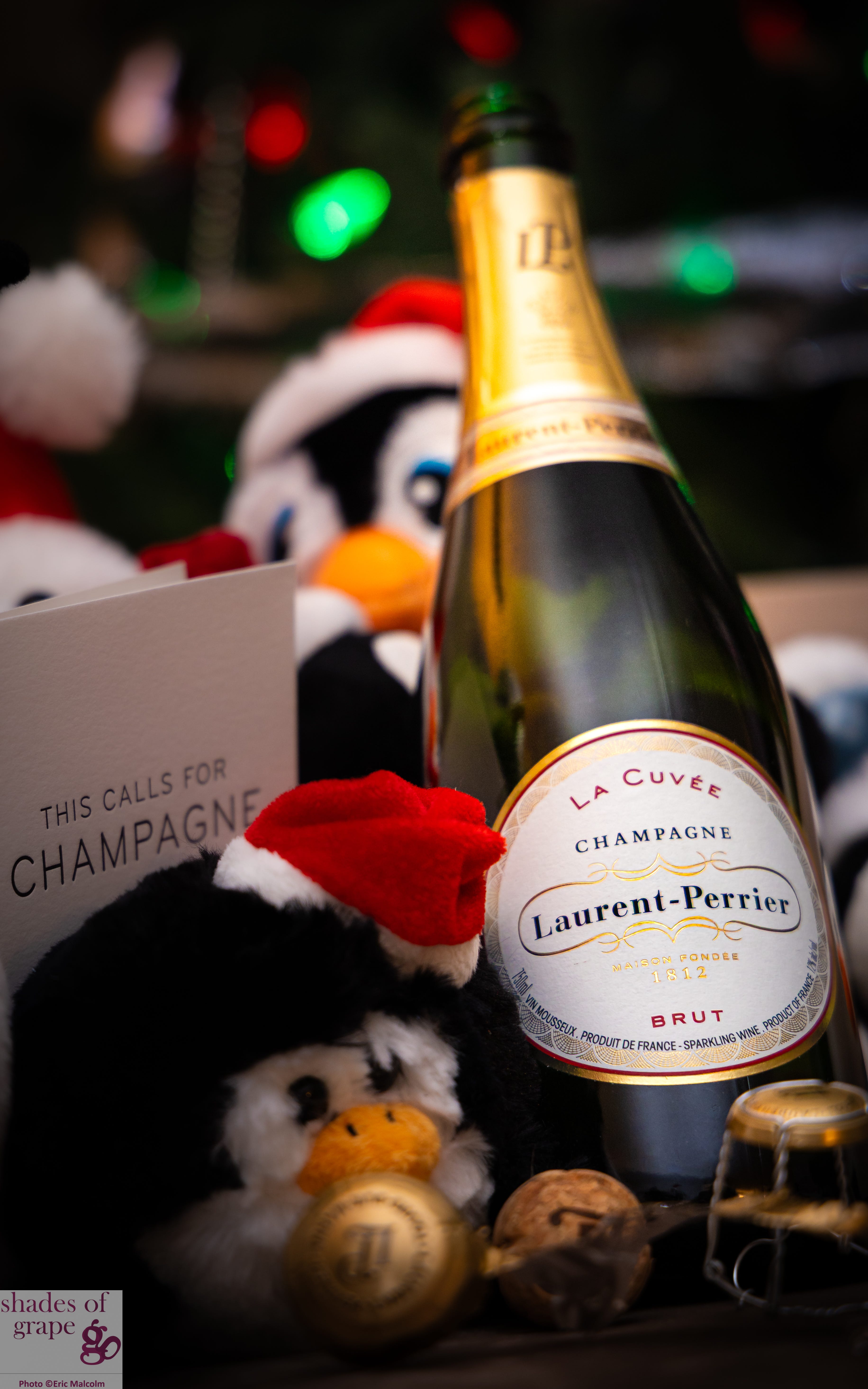
Laurent-Perrier ‘La Cuvée’ NV, from Champagne, France
Style: Dry Medium Body Sparkling White Wine
Varieties: 50%+Chardonnay, 30-35% Pinot Noir, 10-15% Meunier
This super complex sparkling wine has flavours of green apple, lemon, lime, caramel, honey, ginger, pastry, and cedar. (These notes are reminiscent of candied or caramel apple, cookie dough, or apple strudel, all in the most positive light without the sweetness.) This high intensity wine has a fine mousse, precision of flavours, and a long finish.
Our pairings: Prawns in garlic & butter (on cast iron on the grill), Round 2: Reheat the same cast iron pan and cook crab cakes (serve with Sriracha sauce & aioli), Round 3: Reheat again - this time with fish cakes (serve with Sriracha sauce & aioli).
Best pairings: Seafood (see our pairings above), Seafood ravioli with a lemon butter sauce, Cacio e pepe, Prosciutto-wrapped melon, buttery puff-pastry bites, Potato chips, Popcorn, or Nuts, Cheeses: Fresh goat cheese, Brie, or Triple-cream cheeses.
Serving Temperature: 6 - 8 degrees Celsius
Serving Tips: Pop, pour & enjoy but remember the keep the bottle chilled! (to preserve the bubbles!) I particularly loved it paired with food
Price: ~$79 Cdn
Relevant Shades of Grape links: Keep scrolling
If you're in Alberta and want a one-on-one wine curation experience, please reach out! No commitment or minimum purchase required. Interested? Please reach out!
A huge thank you to my paid subscribers—your support helps cover the costs of creating these weekly articles.
Love my wine recommendations? Enjoy my personal wine curation service? If you find value in my writing, consider upgrading to a paid subscription to help me keep sharing the world of wine with you!
Subscribers receive 15% off Wine & Spirits whenever shopping at Cork Fine Wines, ground floor, Bow Valley Square in Calgary.
LINKS TO RELEVANT PAST SHADES OF GRAPE ARTICLES:


SOURCES:
Abbaye d’Hautvillers - Union des Maisons de Champagne (no date). https://maisons-champagne.com/en/houses/heritage/epernay-and-surrounding-area/article/abbaye-d-hautvillers?utm_source=chatgpt.com.
Champagne and its history | Champagne.fr (no date). https://www.champagne.fr/en/about-champagne/champagne-and-its-history.
Dom Perignon - The Monk, the Legend & The Wine (no date). https://www.rarewineinvest.com/news/2021/dom-perignon-the-monk-the-legend-the-wine/?utm_source=chatgpt.com.
Dom Pérignon: Fact & fiction (2019). https://www.guildsomm.com/public_content/features/articles/b/tom_stevenson/posts/dom-perignon?utm_source=chatgpt.com.
Du Tourisme Hautvillers, O. (2025) The 10 must-sees to discover in Hautvillers. https://www.tourisme-hautvillers.com/en/hautvillers-2/?utm_source=chatgpt.com.
Harding, J. and Robinson, J. (2023) The oxford companion to wine. Oxford, United Kingdom: Oxford University Press.
L’histoire du Champagne | Champagne.fr (no date a). https://www.champagne.fr/fr/decouvrir-le-champagne/histoire-du-champagne?utm_source=chatgpt.com#origines.
Robinson, J. (2003) Vines Grapes & Wines: The wine drinker’s guide to grape varieties. McArthur & Co. Publishing.
Sanderson, & Thomas, R. (2025, December 6). Nitrogen | Definition, Symbol, Uses, Properties, Atomic Number, & Facts. Encyclopedia Britannica. https://www.britannica.com/science/nitrogen
The birthplace of Champagne (no date). https://www.champagne-patrimoinemondial.org/en/decouvrir/birthplace-champagne?utm_source=chatgpt.com.
Wine & Spirit Education Trust (2025) D3: Wines of the World - An accompaniment to the WSET Level 4 Diploma in Wines. Version 1.2. London: Wine & Spirit Education Trust.
Ahh the history and prestige from one of the absolute GOAT wine regions of the world. So interesting!
Love this!!