
Wanna DRINK BETTER? Reach out for one-on-one curation time with me with no commitment or minimum purchase required.
Subscribing is a way to show your appreciation for:
my wine recommendations,
any assistance I provide along your wine journey, or
my writing entertainment!
I have often touched on monastic influences on wine, including some subregions that were even established by the monks.
What no Romans?
Not always.
Greeks? How about Etruscans?
Sometimes not!
I’d like to focus specifically on the Benedictine monks today.
Why’s that?
I went away a few weeks ago to Oklahoma for my nephew’s priestly ordination within the Benedictine order.
Do they grow grapes?
They sure do!
The Cynthiana grape which is a black grape known as a hybrid.
You haven’t spoken much about that grape.
That is because most of the world’s wine is made with Vitis vinifera, a European grape species, while hybrid grapes are just what you would expect, a hybrid of two species. In this case the species are both American. Cynthiana is (almost) identical genetically to the Norton grape. The origin appears to be disputed between Virginia or Arkansas depending on the source.
Fun Fact: Cynthiana is the official state grape of Arkansas.
So glad I am blessed with that knowledge! Not too much of it makes it on the export market I suspect.
No.
Benedictine monks have centuries of experience in grape growing and winemaking. Take the Beaujolais, France region for example, where they established vineyards as early as the 7th century.
Dom Pierre Pérignon is perhaps the most famous Benedictine monk due to his impact on Champagne.
MMMmmm Champagne.
You have not written about him.
Surprisingly no. I am saving it for the right moment.
Give us a hint.
He was a 17th-century Benedictine monk at the Abbey of Saint-Pierre d’Hautvillers, France. He has been credited with inventing Champagne. This belief shortchanges other influential figures, as the Champagne we know today has been an evolution. But he gets mega points for devoting his life to the Champagne cause.
Indeed, likely guaranteeing him a spot in heaven!
One should hope so, it is a benediction after all!
Now I want to know more about him and Champagne’s evolution!
Consider this foreshadowing.
Now let’s stay in France but head to Ventoux subregion in southern France’s Southern Rhône Valley. I HAVE written about Ventoux, but first let’s focus on the Sainte-Madeleine Abbey in Le Barroux southern France.
Established in 1970 by Dom Gérard Calvet, this monastery is founded on the Benedictine ethos of Ora et Labora – pray and work. Approximately 60 resident monks pray 7 times a day starting at 3:30 am.
Are these guys into wine?
Patience young padawan.
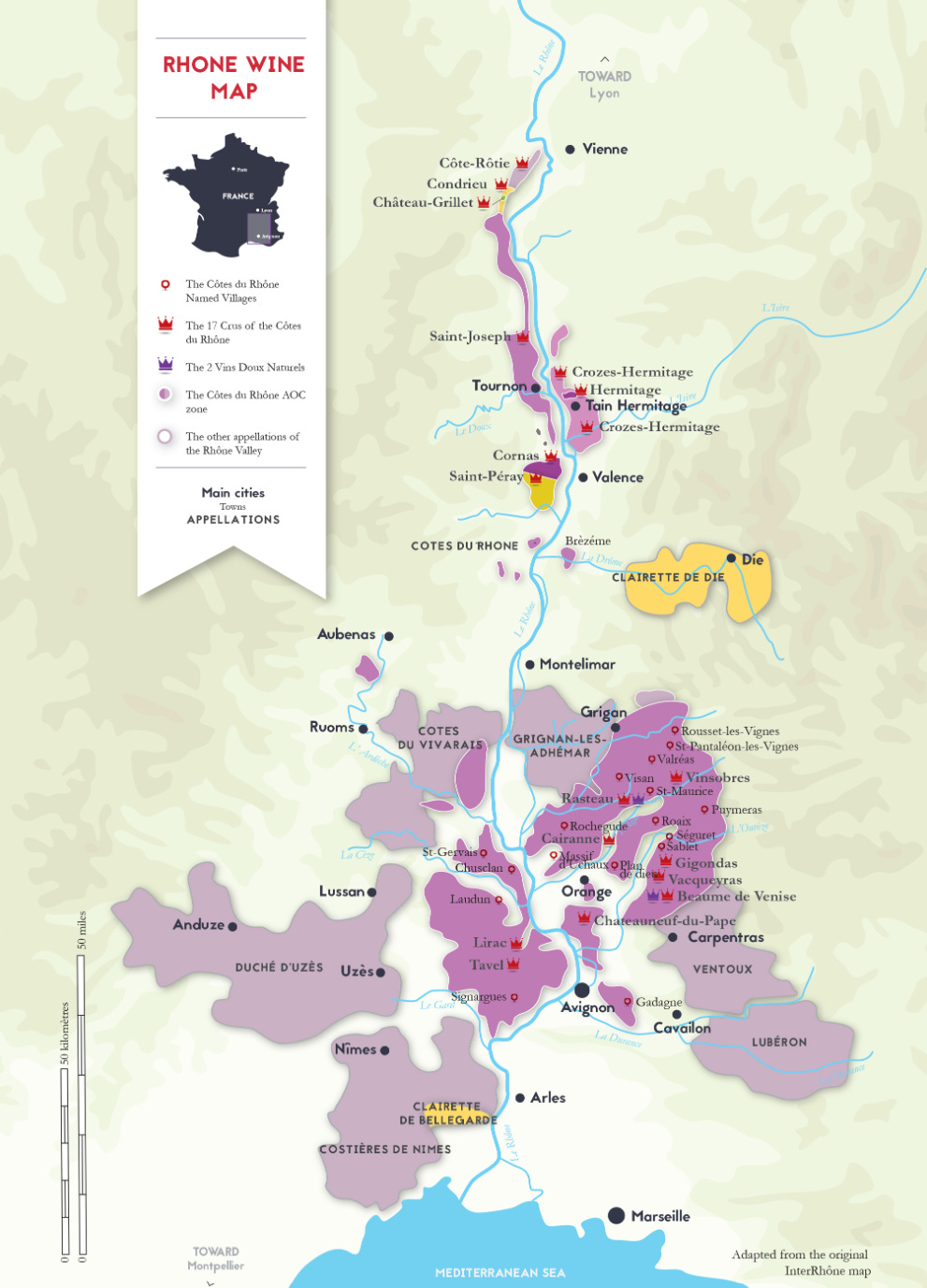
It is believed that the first papal vineyard was established in 1309 near the original Sainte-Madeleine Abbey in Le Barroux, whose ruins still exist. This vineyard pre-dates the Châteauneuf-du-Pape subregion.
Whoa, okay that is kinda cool.
Pope Clement V came to the Rhône Valley in 1309 when the monks relinquished their monastery to become the papal palace.
You have written about Clement V. That dude was into Rhône wines.
Yes, according to the Oxford Companion to Wine, 75% of the papal court’s wines came from the Rhône. (Although Burgundy was up there too!)
Fast forward 600+ years later, Dom Gérard Calvet founded the current monastery with the same name as the original abbey. If you want a little inspiration and knowledge about the monks check out this very interesting video.
So I will beat you to it. When does the featured wine come in, you ask?
In 2015, after a very good harvest, the monks decided to suggest a partnership between the monks and nuns of the Abbeys of Le Barroux, and the subregion’s grape growers to pool resources and know-how. From this, project Via Caritatis was born. The lands cultivated include the papal vineyard I mentioned above.
The wines are sold under the name Via Caritatis – via meaning way or path, and caritatis meaning charity or love in Latin. On the bottle photo you will see written on the cork: Si je n’ai pas la charité, je ne suis rien. ‘Without charity I am nothing.’
This particular wine is a red blend called Vox In Deserto red. Vox means voice, echo, or song in Latin. This comes from the aim ‘To be men who listen to the word.’ In Christianity, word comes from the Greek word Logos which can also be translated into the divine order.
So I interpret this as drinking wine is charitable and divine! Let’s pour it out man!
Who would you recommend this wine to?
Someone who likes savoury wines that have dark fruit flavours.
I don’t really know what flavours are in the wines I like – can you dumb it down please. Sheesh.
In this case, it is easier to say what it isn’t. Red fruit tends to be brighter and sometimes even has a slightly sour note. I like to refer to this as higher frequency fruit notes. Think cranberry or sour raspberry being the highest frequency fruit notes. Continuing through the frequency, the flavours would then ‘drop’ to strawberry and then red cherry.
Okay – I kind of get where you’re coming from. So the featured wine is the opposite of this?
Yes exactly. In between this and the featured wines there are roughly two other “frequency stages” I would say.
Imagine the transition from red fruit to blue fruit like blueberries and less ripe blackberries. Then you get into full black fruit flavours evolving from black cherry to black currant (cassis) to dried black currants.
The fruit almost becomes fruit leather snack flavoured, as it has deeper (aka lower frequency) flavours of dried fruit without the sweetness.
I think you could write a whole post on this.
I plan to. Above is just for red wines. Whites have a different taste profile of course - but my frequency rules apply!
Ultimately, this wine is definitely not fruity, meaning it is less fruit dominant and has more emphasis on herbal, savoury, and earthy notes.
Okay I am saturated with information and THIRST – I am scrolling down to the wine description and the links to relevant past posts.
Enjoying my recommendations? Consider upgrading to a paid subscription.
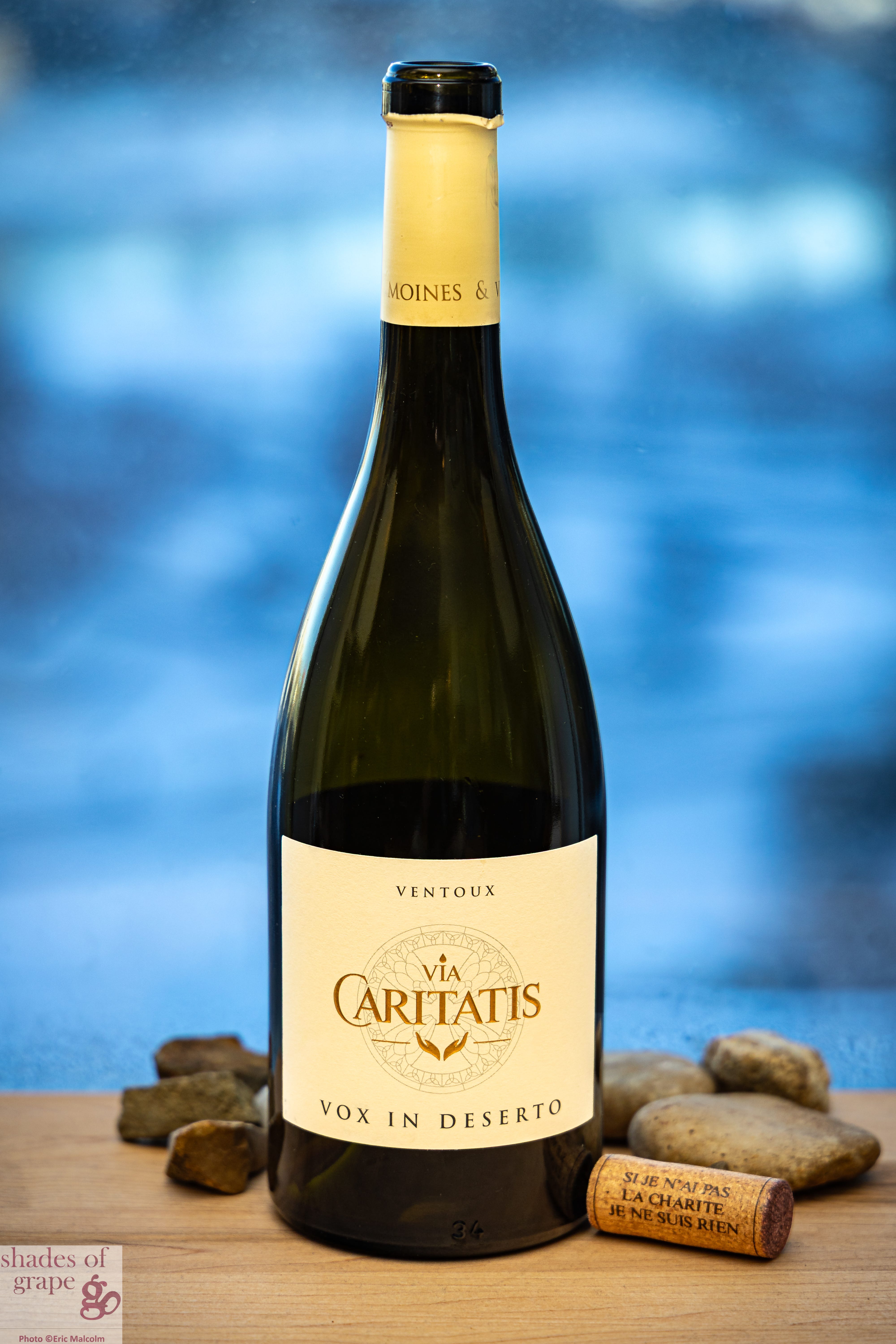
Via Caritatis ‘Vox In Deserto’ Red 2019 from Ventoux, Rhône Valley, France
Style: Full Body Old World Style Red Wine
Varieties: 60% Syrah, 30% Grenache, & 10% Marselan
This predominantly savory wine has sour blackberry, blueberry, cooked black cherry, herbal (sage, rosemary, and mint), animal, sweaty saddle, stinky cheese, and dark chocolate notes. This higher intensity wine has ripe chalky high tannins, and a long finish.
Best pairings: Herb crusted roasted lamb, Beef Bourguignon, Herbes de Provence duck, Grilled portobellos, Charcuterie platters, Cheeses: Comté, Aged Gouda, or Tomme de Savoie
Serving Temperature: 16-18 degrees Celsius
Serving Tips: A quick decant was great, 60 minutes is even better!
Price: ~$26 Cdn
Relevant Shades of Grape links: Keep scrolling
If you're in Alberta and want a one-on-one wine curation experience, please reach out! No commitment or minimum purchase required. Interested? Please reach out!
A huge thank you to my paid subscribers—your support helps cover the costs of creating these weekly articles.
Love my wine recommendations? Enjoy my personal wine curation service? If you find value in my writing, consider upgrading to a paid subscription to help me keep sharing the world of wine with you!
Subscribers receive 15% off Wine & Spirits whenever shopping at Cork Fine Wines, ground floor, Bow Valley Square in Calgary.
LINKS TO RELEVANT PAST SHADES OF GRAPE ARTICLES:


SOURCES:
Barroux Abbey (2025) The history of the monastery - Abbaye du Barroux. https://www.barroux.org/en/history-of-the-monastery/.
EWTN (2021) Monks making wine at a 14th century vineyard | EWTN News in depth. (video)
GmbH, W. (2017) Norton. https://glossary.wein.plus/norton.
Harding, J. and Robinson, J. (2023) The oxford companion to wine. Oxford, United Kingdom: Oxford University Press.
Home - Via Caritatis - Une voie plus excellente - Un Pape, des Moines et des Vignerons - Mont Ventoux (2021). https://www.via-caritatis.com/?lang=en.
LibGuides: CARITAS CENTER: HOME (no date). https://libguides.brescia.edu/CARITAS/home#:~:text=Caritas%20is%20a%20Latin%20word,charity%22%20or%20%22love%22.
Official state grape (2024). https://encyclopediaofarkansas.net/entries/official-state-grape-3118/?utm_source=chatgpt.com.
Robinson, J. (2003) Vines Grapes & Wines: The wine drinker’s guide to grape varieties. McArthur & Co. Publishing.
Vukovic, P. (2024) Rhone Valley Wine Map, Wine Scholar Guild. Available at: https://www.winescholarguild.com/wine-maps/french-wine-maps/rhone-valley-wine-map (Accessed: 19 June 2025).
Wine & Spirit Education Trust (2025) D3: Wines of the World - An accompaniment to the WSET Level 4 Diploma in Wines. Version 1.2. London: Wine & Spirit Education Trust.
Your "frequency" method was so helpful, and continues to shine a light on fruit aroma/flavor descriptors for me. It is a game changer when learning to taste wine! I loved this article. The fun thing about wine is that it is not just the wine in the glass, but the history and geography behind it. So cool.
Excellent post. I think it's worth mentioning that the monasteries became centers of winemaking because they were one of the few places that had the time and the capital to do so.