
Private shops appointment still available. Drink better! Reach out for one-on-one curation time with me with no commitment or minimum purchase required.
Subscribing is a way to show your appreciation for:
my wine recommendations,
any assistance I provide along your wine journey, or
my writing entertainment!
Some of you know that I did my WSET Diploma classes (final level or level 4) in Austria and Tuscany. When you spend that much time in an area you can’t help but learn about the wines.
In Calgary, there is now snow on the ground and background Christmas tunes are playing in retail stores everywhere.
So, it seemed fitting to feature a wine that I love during the Christmas season. A sweeter wine.
Ugh – hate sweet wines.
You must have amnesia.
You do not hate sweet wines. You hate cheap wines. Period
Regardless, this wine is closer to medium-sweet. These types of wines (whether medium-sweet or sweet) shine with dessert.
I would pair this one with a not super sweet dessert. Like a lemon meringue tart.
How about something more festive?
Fruitcake, Pannetone, Spice cake, and shortbread cookies!
Yum! Where are we going in terms of country?
Austria.
Region?
Niederösterreich (aka Lower Austria)
Never heard of it.
Understandable.
Subregion?
Thermenregion.
Still drawing a blank.
It is a very new wine subregion created in 2023.
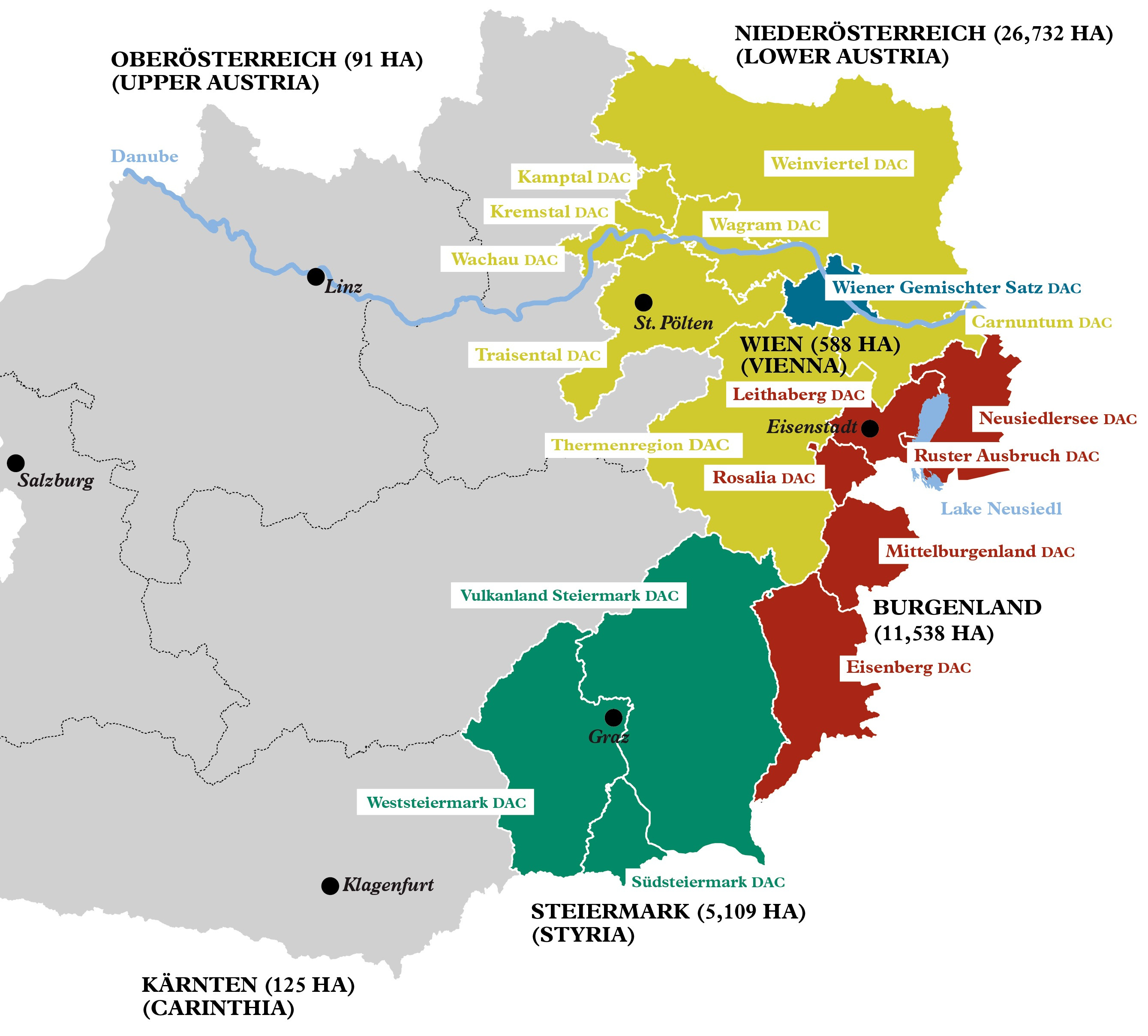
I took most of my classes and exams for the Diploma on the west side of Lake Neusiedl, super close to the Hungarian border, in the small town of Rust where the Ruster Ausbruch subregion lies. It is about a 10-minute drive to Eisenstadt, the city famous for being where Haydn, the Austrian composer, lived from 1766 to 1790 and where his tomb is located.
This is in the Burgenland wine region of Austria. The Thermenregion subregion, named for the area’s hot springs, is located in the Lower Austria wine region, right next door to Burgenland.
Red wines in Thermenregion are made with Pinot Noir/Spätburgunder and Sankt Laurent/St Laurent, while the whites use Rotgipfler (the featured grape) and Zierfandler/Spatröt.
Rotgipfler has a very attractive brightness, which is awesome for sweet wines as it balances the sweet flavours. It is often compared to Chenin Blanc, which also makes delicious sweet wines, likely for the same reason.
Would you say it has high frequency flavours?
Someone paid attention last week (see link at the end of this article)!
Yes, it has a zingy yet rich lemon note which I describe as high frequency. Even the ripe peach and mango flavours have some zing … they are typically a little lower frequency to me.
Honestly, I did not know what to expect with this wine. However, I was very impressed and assessed it as outstanding.
The Rotgpfler grape is a natural cross of Savagnin/Traminer and Roter Veltliner which likely occurred locally. It is effectively not grown anywhere else.
Doesn’t “rot” mean red in German? Yet this is a white grape, correct?
Yes, the vine’s shoot tips are reddish bronze, which is how it got its name.
Although I mentioned Thermenregion is a very new subregion, that doesn’t mean that grape growing and winemaking is new there. It goes back to the region’s pre-Roman days in 400 B.C. when the Celts grew grapes in the area. Winemaking accounting documentation dating back to 1326, possibly the oldest in Austria, shows wine quantities from the regional town of Gumpoldskirchen.
I have never heard the term medium-sweet before.
For sweetness/dryness in wines, the WSET (Wine and Spirit Education Trust) uses a 5-category scale. Each category has technical values to define them, which need to be learned for theory exams. As far as tasting assessment goes, the palate determines the category – so let’s focus on that!
The easiest way to describe this is with the two opposing ends of the categories, namely Dry and Sweet. Dry is where no sweetness is perceived on the palate, and Sweet is where sweetness is the wine’s defining feature.
The next category that is easy to understand, Off-dry, shows just a small perception of sweetness. This is a small band.
The hardest categories to define, and this takes practice (well they all take practice), are the Mediums. I like to think of them as the “bookends once removed” from dry and sweet.
As the name implies, Medium-dry is the drier of the two. These wines pair nicely with spicy food as opposed to dessert, while Medium-sweet is defined more as sweet…
…and would pair with dessert.
The rule of dessert wine pairing is that the wine needs to be as sweet or sweeter than the dessert. And most desserts are quite sweet. One also can think of the weight or the body of the wine. If it really envelops your mouth, the sugar content is such that it is on the sweet or medium-sweet scale.
The summarized categories from dry to sweet are:
Dry: no perception of sweetness.
Off-dry: has a small perception of sweetness.
Medium: is split in two categories:
Medium-dry: more than a perception of sweetness. One distinguishes it from medium-sweet as a wine that pairs better with a non-dessert. Many people mistake these wines for off-dry.
Medium-sweet: definitely sweet but not full-on sweet – would pair better with desserts that are less sweet.
Sweet: sugar is the wines defining feature.
Note: these categories are defined differently for sparkling wines.
It is common for people to perceive sweetness when a wine is fruity/fruit dominant, especially in whites. Our brain associates fruit with sugar because fruit is sweet. But the flavour compounds of fruit in wine are not actually sweet, they are just flavours.
Meaning it is the sugar in wine that is sweet, not the flavour compounds?
Exactly.
Sweet spice or baking spice also gives this perception. Cinnamon - I put that on my unsweetened yogurt, and I’d swear it makes it sweeter. BUT cinnamon is not sweet, yet we associate sweetness with it in baking or cinnamon toast, etc.
Fascinating. And a good diet trick!
The brain plays tricks on us!
How does this fit into your personal wine journey? Why is this wine relevant to you?
When sweet wines are done properly, they are divine. I love to end a meal with them – no better way to linger with friends, cheese, nuts, and dessert!
This one is no exception.
I remember tasting some sweet wines during my early WSET sessions. I would look at the glass lovingly thinking “where have you been all my life”.
This one is low alcohol as it is NOT a fortified wine (Port, Madeira & Sherry) where alcohol spirit is used to stop fermentation. For this wine they didn’t allow all the sugar to be converted to alcohol like for a dry wine. So this is a nice bonus at the end of the night.
Perfect! Cannot wait to read about the featured wine description below and click all the links you have at the bottom of this post!
Enjoying my recommendations? Consider upgrading to a paid subscription.
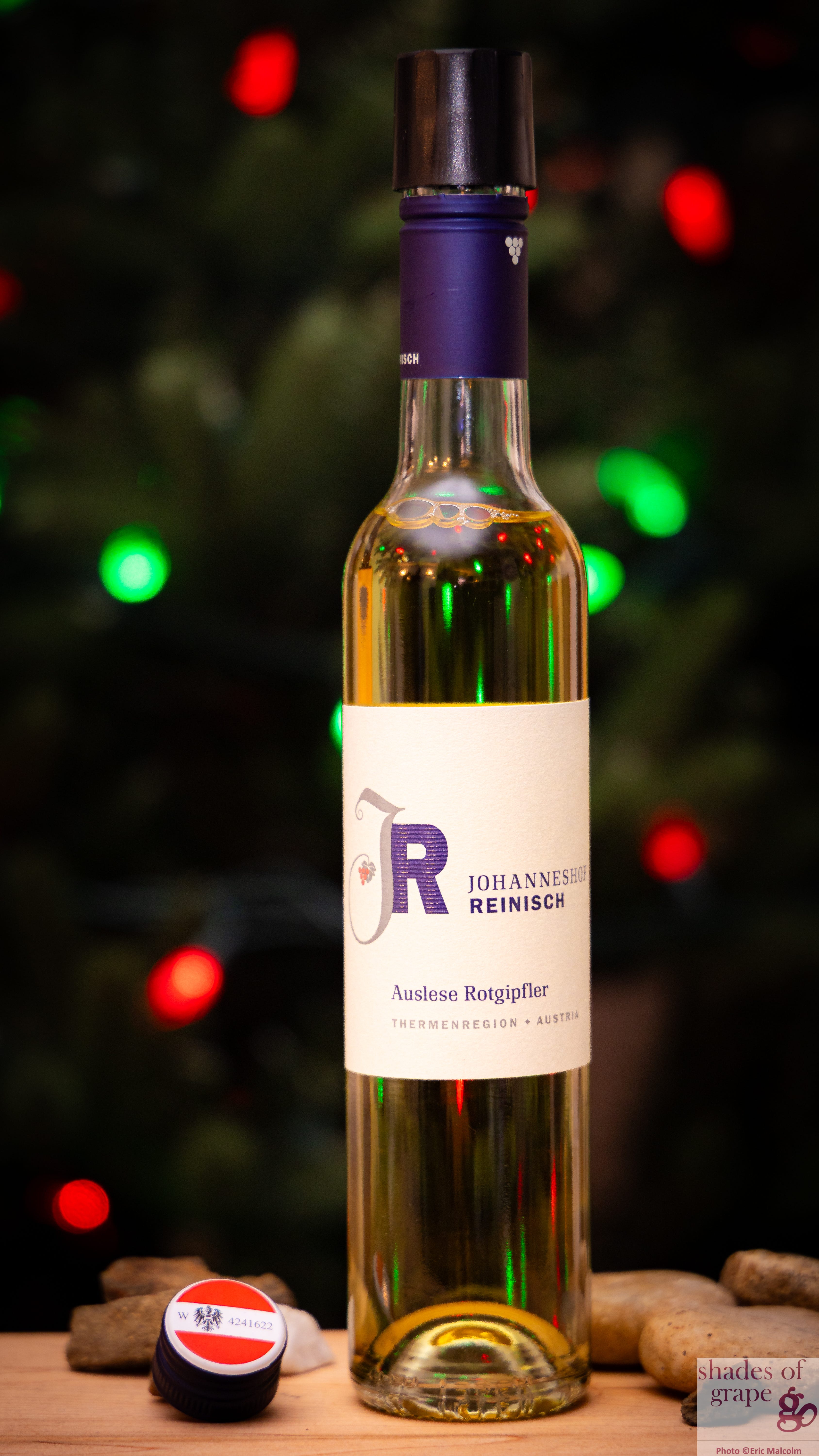
Johanneshof Reinisch Auslese Rotgibfler 2018 from Thermenregion, Niederösterreich (aka Lower Austria), Austria
Style: Medium Body Medium-Sweet White Wine
Varieties: Rotgibfler
This rich yet bright wines has flavours of ripe lemon, lemon curd, ripe peach, mango, and cream. This high intensity wine has precision of flavours, and a long finish. Quality: Outstanding.
Best pairings: Peach cobbler, Lemon meringue tart, Panna cotta with a fruit glaze, Fruitcake, Pannetone, Spice cake, and Shortbread cookies! Nuts: Almonds & Cashews, Cheeses: Blue cheese, Aged Gouda, Creamy goat cheese.
Serving Temperature: 6 -8 degrees Celsius
Serving Tips: Pour & enjoy!
Price: ~$34 Cdn
Relevant Shades of Grape links: Keep scrolling
If you're in Alberta and want a one-on-one wine curation experience, please reach out! No commitment or minimum purchase required. Interested? Please reach out!
A huge thank you to my paid subscribers—your support helps cover the costs of creating these weekly articles.
Love my wine recommendations? Enjoy my personal wine curation service? If you find value in my writing, consider upgrading to a paid subscription to help me keep sharing the world of wine with you!
Subscribers receive 15% off Wine & Spirits whenever shopping at Cork Fine Wines, ground floor, Bow Valley Square in Calgary.
LINKS TO RELEVANT PAST SHADES OF GRAPE ARTICLES:


SOURCES:
Austria (no date). https://wineguide.wein.plus/wine-regions/austria.
Austrianwine.com. (2024). Rotgipfler. [online] Available at: https://www.austrianwine.com/our-wine/grape-varieties/white-wine/rotgipfler [Accessed 5 Dec. 2025].
Britannica Editors (1998). Eisenstadt | Baroque Architecture, Burgenland & Music. [online] Encyclopedia Britannica. Available at: https://www.britannica.com/place/Eisenstadt [Accessed 5 Dec. 2025].
Geiringer, K. and H.C. Robbins Landon (2019). Joseph Haydn | Biography, Compositions, & Facts. In: Encyclopædia Britannica. [online] Available at: https://www.britannica.com/biography/Joseph-Haydn.
GmbH, W. (2017) Rotgipfler. https://glossary.wein.plus/rotgipfler.
Harding, J. and Robinson, J. (2023) The oxford companion to wine. Oxford, United Kingdom: Oxford University Press.
Pigott, S. et al. (no date) WEINLAND THERMENREGION. https://www.thermenregiondac.at.
Robinson, J. (2003) Vines Grapes & Wines: The wine drinker’s guide to grape varieties. McArthur & Co. Publishing.
Thermenregion DAC (2018) Rotgipfler. https://www.thermenregiondac.at/en/wine/rotgipfler/.
Wine & Spirit Education Trust (2025) D3: Wines of the World - An accompaniment to the WSET Level 4 Diploma in Wines. Version 1.2. London: Wine & Spirit Education Trust.
Loved this article! We need more sweet wines in our life for sure! Skip the desert, pour the wine!
Love Reinisch wines! Fun article.