
Drink better this year! I offer wine orders customized to your palate. Reach out for one-on-one curation time with me with no commitment or minimum purchase required.
Subscribing is a way to show your appreciation for:
my wine recommendations,
any assistance I provide along your wine journey, or
my writing entertainment!
So much to say so little time!
For my last article I wrote about Provence, whose raison d’être seems to be amazing rosé.
And yet you featured a white Vermentino!
Keeping you on your toes, baby!
And now we are going to Abruzzo where Montepulciano is the red grape of the region…
And let me guess …
I am going to write about rosé – well rosato in Italian!
I knew it!
I told you these articles revolve around the wines I find! And regardless, their rosé has a special name: Cerasuolo! How fun is that!
I love saying it: Cerasuolo, Cerasuolo, Cerasuolo with a ‘ch’ sound like chicken!
And it is made with a minimum of 85% Montepulciano.
Remind me about the confusion around Montepulciano again.
Thought you would never ask!
Montepulciano is a town and a grape. The municipality is in Tuscany, but Montepulciano, the grape, is not grown there. Tuscany’s famous wine, Vino Nobile di Montepulciano, is made from mostly the Sangiovese grape.
Montepulciano, the grape, is widely grown in Italy, particularly in the Abruzzo and Marche regions. You may have heard of the wine named Montepulciano d’Abruzzo. In that case Montepulciano is the grape and Abruzzo is the region.
Do they have anything in common?
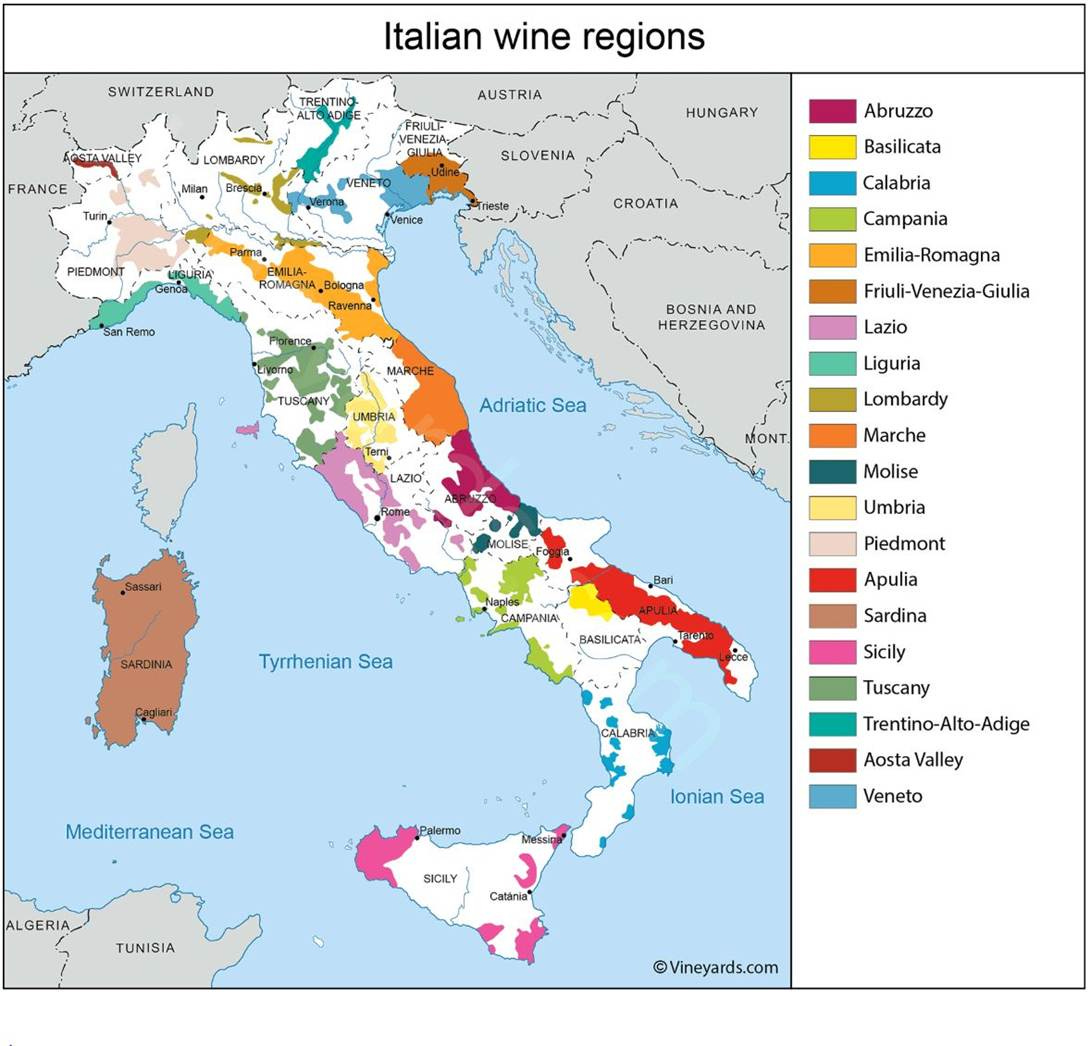
Quite a bit actually. Both Tuscany and Abruzzo are in Central Italy. Tuscany is on the west side and influenced by the Mediterranean, while Abruzzo is on the East side with Adriatic Sea effects. On the Italian wine region map below, Tuscany is highlighted in green around Florence, while Abruzzo appears in fuchsia on the Adriatic side of central Italy, east of Rome.
What else do they have in common?
Sangiovese and Montepulciano grapes are both considered to be native to Italy and are the country’s top two most planted black grapes (Sangiovese is number one). They also both have legends associated with them.
I love myself a good wine legend!
Since it is a myth there are several versions. The jest goes that the famous General (and future Roman emperor) Hannibal believed Montepulciano wine healed and strengthened his soldier’s wounds. He even gave his horses Montepulciano baths to make them invincible. One version of the legend says that the baths would heal them of scabies.
The soldiers?
The horses, silly!
Now I want to hear about this rosé with a special name Cher….
Cerasuolo!
Right – it sounds intriguing!
Cerasuolo d’Abruzzo is known for being a darker coloured rosé although it is made a little lighter now than in the past.
Why are some rosés dark in colour while others are so light that they are practically colourless?
Answer: WINEMAKING!
Usually, people prefer one style over the other!
The colour of all wines comes from grape skins since most grapes, regardless of skin-color, have colourless flesh. That is why white wine can be made from black grapes. The best example of this is a Blanc de Noir Champagne which is a white sparkling wine made from black grapes only.
I thought we were talking rosés today, Eveline … (sheesh!)
Ok, that was a tangent …
All rosés are made from black grapes. Whether making sparkling or still wines, there are 3 methods of making rosé:
1. Direct pressing results in the lightest coloured rosés. This is on trend right now. With this method, black grapes are pressed as soon as possible resulting in minimal colour extraction from the skins. This is the traditional Provence style rosé – their palest of rosés are barely pink and sometimes go by the name vin gris. Vin gris translates into grey wine – sounds nicer in French doesn’t it!
Everything does!
2. Blending just enough red wine with white wine to get the desired colour and flavour of rosé! Enough said!
3. Short maceration means the winemaker leaves the juice in contact with the skins for a few hours or a few days after crushing. A longer time gives the darkest rosés. This method was traditionally used to make rosado (rosé in Spanish) from Spain or Tavel rosé within France’s Rhone Valley…
…and Cerasuolo d’Abruzzo!
Yes! However, due to the popularity of the Provence style rosés, even these areas now make some direct pressing rosé to keep up with consumer demand.
Figure out which style you prefer so you know what to ask for! Although you can generally tell with the colour if the wine bottle glass is clear.
Okay so tell me more of this Cerasuolo rosé!
It is called Cerasuolo d’Abruzzo. Cerasuolo means pale cherry red. This wine would have a short maceration (up to 12 hours in general). Some will be direct press depending on the producer. The Montepulciano grape is naturally rich in colour, so a little skin contact goes a long way. It is fresh tasting and if time is spend on skins there will be more structure, meaning slight tannin and more body. These will typically be medium to moderately full bodied, making for great food rosés!
NOW Cerasuolo di Vittoria, a wine made in Sicily, is NOT rosé.
Oh man, the Italians do it to me again with more confusion!
Tell me about it! Turns out this is a sub-theme for this article.
In the case of Cerasuolo di Vittoria, Cerasuolo comes from the Sicilian word Ceresa, meaning cherry, referring to the cherry flavours in the wine.
Okay got it!
To wrap things up prior to discussing the featured wine, I would be remiss to not tell you a little blurb about the producer Ciavolich.
That ain’t Italian!
LOL. No, it isn’t! In the 16th century, the Ciavolich family immigrated to Italy from Bulgaria where they were wool merchants. They eventually got into grape growing and winemaking, founding the oldest cellar of the region in 1835.
Super cool. True entrepreneurs! Okay I am saturated with facts, now I want to be saturated with rosé!
Sounds great! Scroll down for the featured wine and relevant Shades of Grape article links.
Ciao ciao!
Enjoying my recommendations? Consider upgrading to a paid subscription.
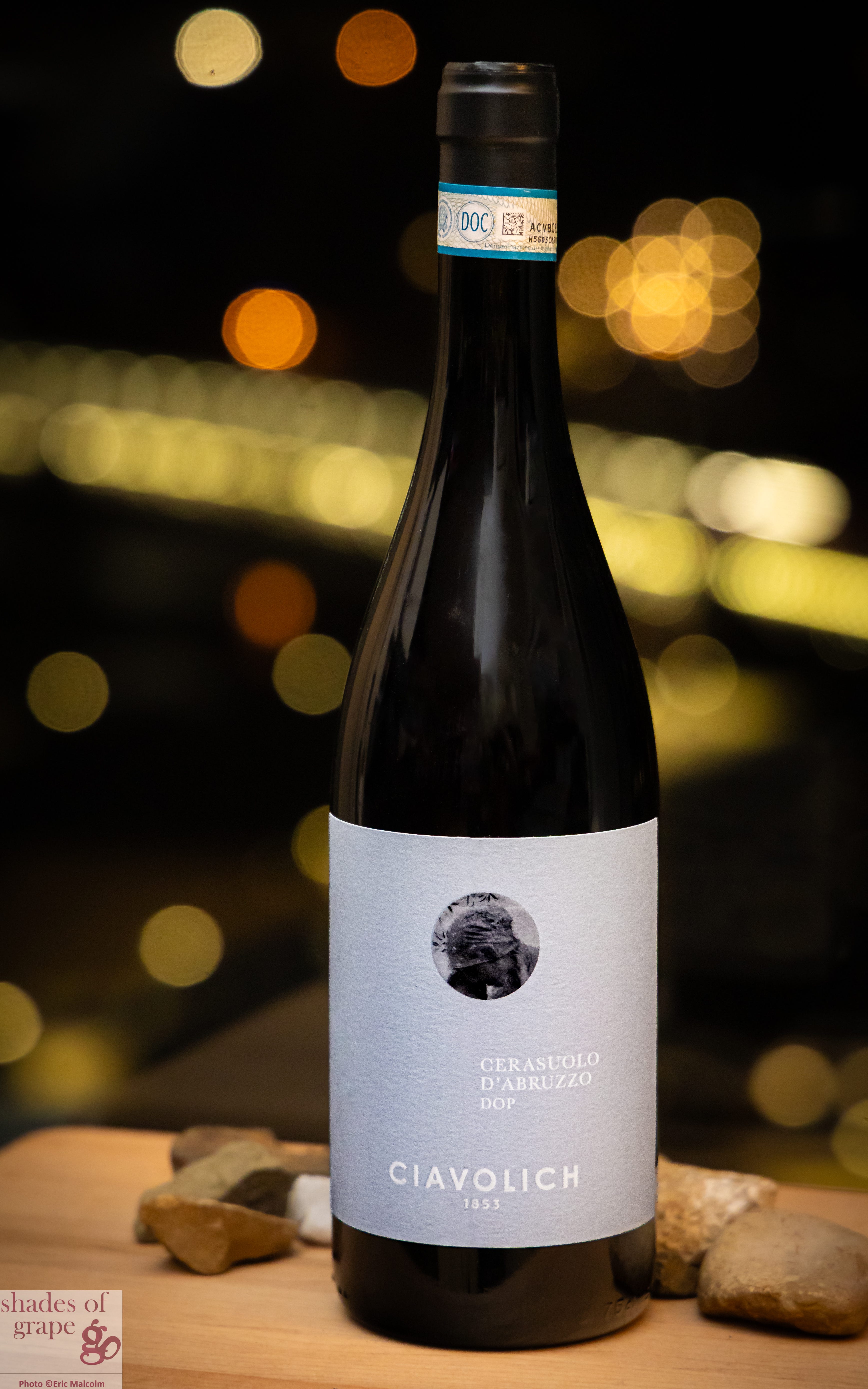
Ciavolich Cerasuolo d’Abruzzo Rosé 2024, Abruzzo, Central Italy
Style: Medium Body Rosé Wine
Variety(ies): Montepulciano
This fresh dry rosé wine has notes of strawberry, red cherry, kirsch, blueberry, pomegranate, and cantaloupe with a hint of mint. This wine is fruit-driven, has medium intensity, very slight tannins, and a long finish.
Best pairings: Pizza, Pasta with tomato or seafood sauces, Grilled fish or poultry, Antipasti, Bruschetta, Green salad with strawberries, feta, and creamy poppy seed dressing, Charcuterie board, Cheese: Young to semi-aged cheeses (pecorino, mozzarella)
Serving Temperature: 8 -10 degrees Celsius
Serving Tips: Enjoy
Price: ~$28 Cdn
Relevant Shades of Grape links: Keep scrolling
If you're in Alberta and want a one-on-one wine curation experience, please reach out! No commitment or minimum purchase required. Interested? Please reach out!
A huge thank you to my paid subscribers—your support helps cover the costs of creating these weekly articles.
Love my wine recommendations? Enjoy my personal wine curation service? If you find value in my writing, consider upgrading to a paid subscription to help me keep sharing the world of wine with you!
Paid subscribers receive 15% off Wine & Spirits whenever shopping at Cork Fine Wines, ground floor, Bow Valley Square in downtown Calgary.
LINKS TO RELEVANT PAST SHADES OF GRAPE ARTICLES:


SOURCES
Abruzzo Information (no date) 10 things you need to know about Montepulciano d’Abruzzo. Available at: https://www.abruzzoinformation.com/en/10-things-you-need-to-know-about-montepulciano-dabruzzo/ (Accessed: 5 February 2026).
Harding, J. and Robinson, J. (2023) The Oxford companion to wine. Oxford: Oxford University Press.
MasterClass (no date) Learn about Montepulciano: grape characteristics, wines, and how to pair Montepulciano. Available at: https://www.masterclass.com/articles/learn-about-montepulciano-grape-characteristics-wines-and-how-to-pair-montepulciano (Accessed: 5 February 2026).
McNeil, K. (2015) The Wine Bible. 3rd edn. New York: Workman Publishing.
Robinson, J. (no date) Abruzzo’s new avant-garde – part 2. Available at: https://www.jancisrobinson.com/articles/abruzzos-new-avant-garde-part-2 (Accessed: 5 February 2026).
Shades of Grape (2023) Chartier, E. Rosé all day!. Available at: https://www.shadesofgrape.ca/p/rose-all-day (Accessed: 5 February 2026).
Shades of Grape (no date) Vino Nobile: the Montepulciano that’s…. Available at: https://www.shadesofgrape.ca/p/vino-nobile-the-montepulciano-thats (Accessed: 5 February 2026).
Vineyards.com (no date) Vineyards.com. Available at: http://www.vineyards.com (Accessed: 5 February 2026).
Wikipedia (no date) Hadrian. Available at: https://en.wikipedia.org/wiki/Hadrian (Accessed: 5 February 2026).
Wine & Spirit Education Trust (2025) D3: Wines of the World — An accompaniment to the WSET Level 4 Diploma in Wines. Version 1.2. London: Wine & Spirit Education Trust.
Wine Insiders (no date) Montepulciano d’Abruzzo. Available at: https://wineinsiders.com/blogs/wine-101-types-of-wines-grapes/montepulciano-dabruzzo (Accessed: 5 February 2026).
I love Cerasuolo! Both the Abruzzo and Vittoria kinds. Two styles that are quite on trend here in Oxford.