
Drink better this year! I offer wine orders customized to your palate. Reach out for one-on-one curation time with me with no commitment or minimum purchase required.
Subscribing is a way to show your appreciation for:
my wine recommendations,
any assistance I provide along your wine journey, or
my writing entertainment!
I’m intrigued by this headline!
Someone getting punished is always intriguing isn’t it? Let’s set the stage with a map. We will head to Portugal and talk about a few wine regions. The Bairrada wine region in red below has the Vinho Verde wine region (in yellow) to the north, Douro (pink) to its northeast, and Dao (gray) to its east.
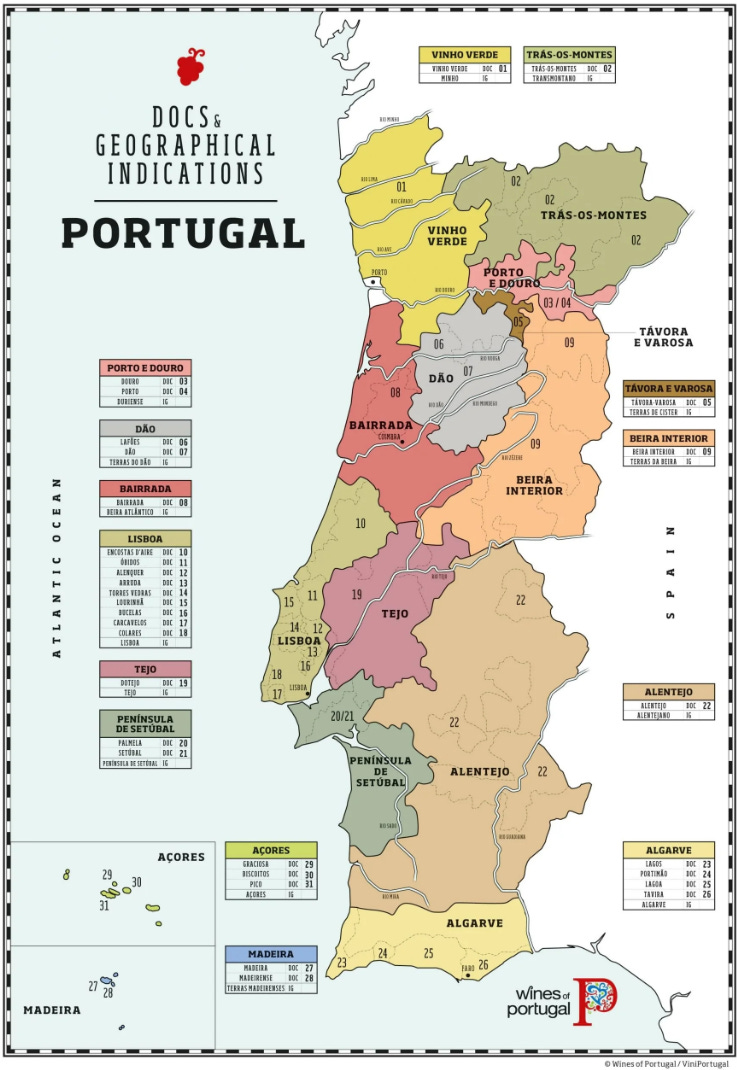
The Douro region is named after the Douro River that runs through it, and is the same region where Port is made. The Douro River is a continuation of the “Spanish” Duero River, which switches names upon crossing the Spanish-Portuguese border and continues about 90 km to the city of Porto, eventually reaching the Atlantic Ocean to the west.
Just south of the Douro River is Bairrada, whose wine history goes back to the 10th century when Portugal ceased being under the Moors’ control. Moving forward in time, Douro’s Port wine demand was higher than the region could supply.
Let me guess …someone found a solution.
Yes. Bairrada wines were marketed under false pretenses and sold either as Port outright, or blended into Port to add more colour and give the illusion of a higher quality wine.
That is a big no-no.
Hence Bairrada’s punishment.
In 1756, the Marquês de Pombal wanted to win back Port’s credibility and rid it of the offending grapes. So he ordered the Bairrada vines pulled to protect the wealth Port brought in! This was devastating to Bairrada’s industry, ultimately taking more than 200 years to get back on its feet.
Bairrada is an interesting name.
One that I keep misspelling. I never know where to put the ‘i’. Interestingly it comes from the word barro, which means clay in Portuguese.
And barro has no i’s so that doesn’t help you.
True! But the soils do contain clay with limestone, with some more sandy.
Do you remember the wine Mateus? The rosé wine in the funny wide bottle.
I remember as a child my aunts drinking it at family gatherings.
Well, it is still on the market. I was shocked when I tasted it blind during my diploma course. Talk about a blast from the past! Mateus started in Bairrada where out of approximately 2500 producers, about 900 sell their grapes to Sogrape, Mateus’ producer.
The Baga grape is the main star here and it grows well in the limestone-clay soils. Its name means “berry” to highlight its small grape size. It’s a black grape, constituting over 75% of the region’s wines, followed by the Alfrocheiro, Tinta Pinheira, and Touriga Nacional varieties. The predominant white grape variety is Fernão Pires (known as Maria Gomes in the region), followed by Arinto, Bical, Cercial, and Rabo de Ovelha.
The featured wine fits the norm, being Baga dominant and blended with Touriga Nacional and Castelão.
Who would you recommend the featured wine to?
Someone who likes a well-made high quality easy drinking wine.
Other than call it high quality, I think that your description can be perceived negatively.
It shouldn’t. It means it is smooth and can be enjoyed with or without food. What it isn’t is high in any one structure.
It is medium body, the tannins are soft, and its finish is long which is a sign of quality. I was very impressed with this wine. A great wine for beginners whose palate has not developed an appreciation for higher tannins and acidity level, or for fuller bodied wines, which can be an acquired taste.
So serious wine drinkers should stay away.
Not at all. This is a great wine, particularly for the price. It may not appeal to everyone’s palate, which goes for any wine or food for that matter.
Check out the detailed wine description below!
I can’t wait to try it!
Enjoying my recommendations? Consider upgrading to a paid subscription.
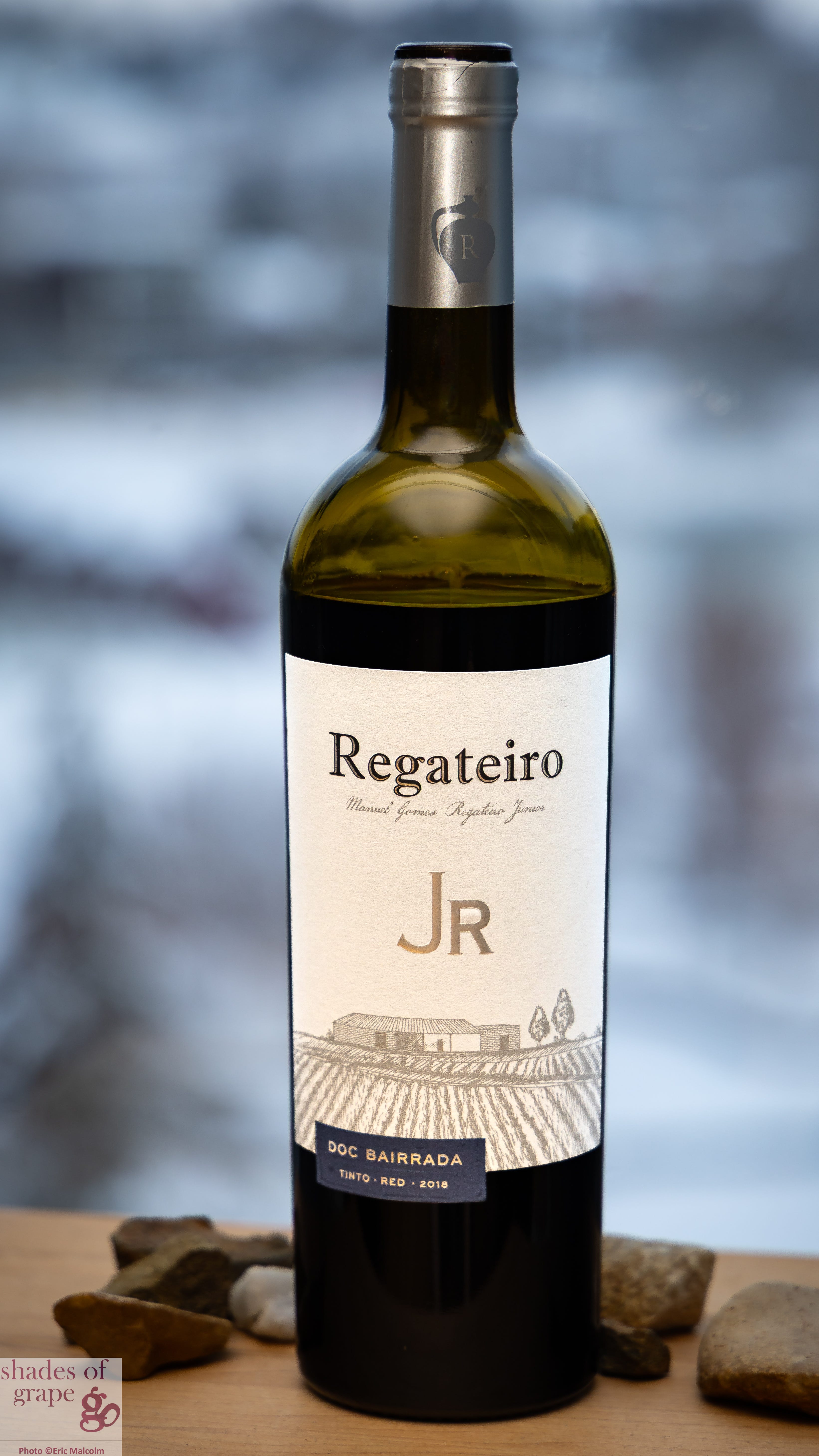
Regateiro ‘JR’ 2018, Bairrada, Portugal
Style: Medium Body Red Wine
Variety(ies): Baga,Touriga Nacional, and Castelão
This lively wine shows red and dark berry fruit—cherry, prune, and forest berries—alongside black pepper and a slightly dry, vegetal edge. It’s medium-bodied with good depth and texture, fresh acidity, soft ripe tannins, and a long finish.
Best pairings: grilled sausages, grilled lamb chops, pork roast, coq au vin, creamy mushroom risotto, Cheese: aged sheep cheese
Serving Temperature: 16-18 degrees Celsius
Serving Tips: Enjoy
Price: ~$26 Cdn
Relevant Shades of Grape links: Keep scrolling
If you're in Alberta and want a one-on-one wine curation experience, please reach out! No commitment or minimum purchase required. Interested? Please reach out!
A huge thank you to my paid subscribers—your support helps cover the costs of creating these weekly articles.
Love my wine recommendations? Enjoy my personal wine curation service? If you find value in my writing, consider upgrading to a paid subscription to help me keep sharing the world of wine with you!
Paid subscribers receive 15% off Wine & Spirits whenever shopping at Cork Fine Wines, ground floor, Bow Valley Square in downtown Calgary.
LINKS TO RELEVANT PAST SHADES OF GRAPE ARTICLES:


SOURCES
Falstaff. (n.d.). Bairrada (Portugal). https://www.falstaff.com/en/regions/portugal-bairrada
Harding, J., & Robinson, J. (2023). The Oxford companion to wine. Oxford University Press.
Instituto da Vinha e do Vinho (IVV). (n.d.). IVV official website. https://www.ivv.gov.pt/np4/785/
Intowine. (n.d.). Bairrada: Home of Portugal’s Baga grape. https://www.intowine.com/bairrada-home-portugals-baga-grape
McNeil, K. (2015). The wine bible (3rd ed.). Workman Publishing.
Vinerra. (n.d.). Baga: An in-depth wine profile. https://vinovoss.com/regions/bairrada-portugal/
VinoVoss. (n.d.). Bairrada wine region. https://vinovoss.com/regions/bairrada-portugal/
Wines of Portugal. (n.d.). Bairrada wine region. https://winesofportugal.com/en/discover/wine-regions/bairrada/
Wine & Spirit Education Trust. (2025). D3: Wines of the world — An accompaniment to the WSET Level 4 Diploma in Wines (Version 1.2). Wine & Spirit Education Trust.
Bairrada is one of my favorite finds! My husband and I were introduced to it at a lovely wine shop in Sintra, Portugal, and we are always seeking it out here in the US. I've been seeing more of it lately, and it's very exciting!
Baga is a glorious grape! Enjoy it!!