
Private shops appointment still available. Drink better! Reach out for one-on-one curation time with me with no commitment or minimum purchase required.
Subscribing is a way to show your appreciation for:
my wine recommendations,
any assistance I provide along your wine journey, or
my writing entertainment!
The evolution of Champagne spanned more than 200 years. Last week’s article discussed Dom Pérignon and his part in Champagne’s progression. When he died in 1715, there were still problems with the Champagne sparkling wines that would not be resolved for more than 100 years!
That’s a long time. I guess these would be what you call “Champagne problems!”
Ha ha – yes! It’s definitely a Champagne problem when the bubbly is cloudy.
Ugh not very inviting? Why was it cloudy?
Because the Champagne was bottled before completing fermentation, this meant yeast was naturally entrained in the bottles along with the wine. The yeast in suspension made the wine cloudy. Some would choose to decant prior to serving, but that led to bubble dissipation.
Where is the fun in that!!
Eventually, a solution was found by German born Anton von Müller (1788-1859), cellar master at the famous Champagne house, Veuve Clicquot. In the early 1800s, von Müller started to gradually twist and rotate bottles in short increments over time, gradually bringing the bottles from horizontal to a vertical upside-down position. This is called remuage –from the French word remuer (to move around) - riddling in English.
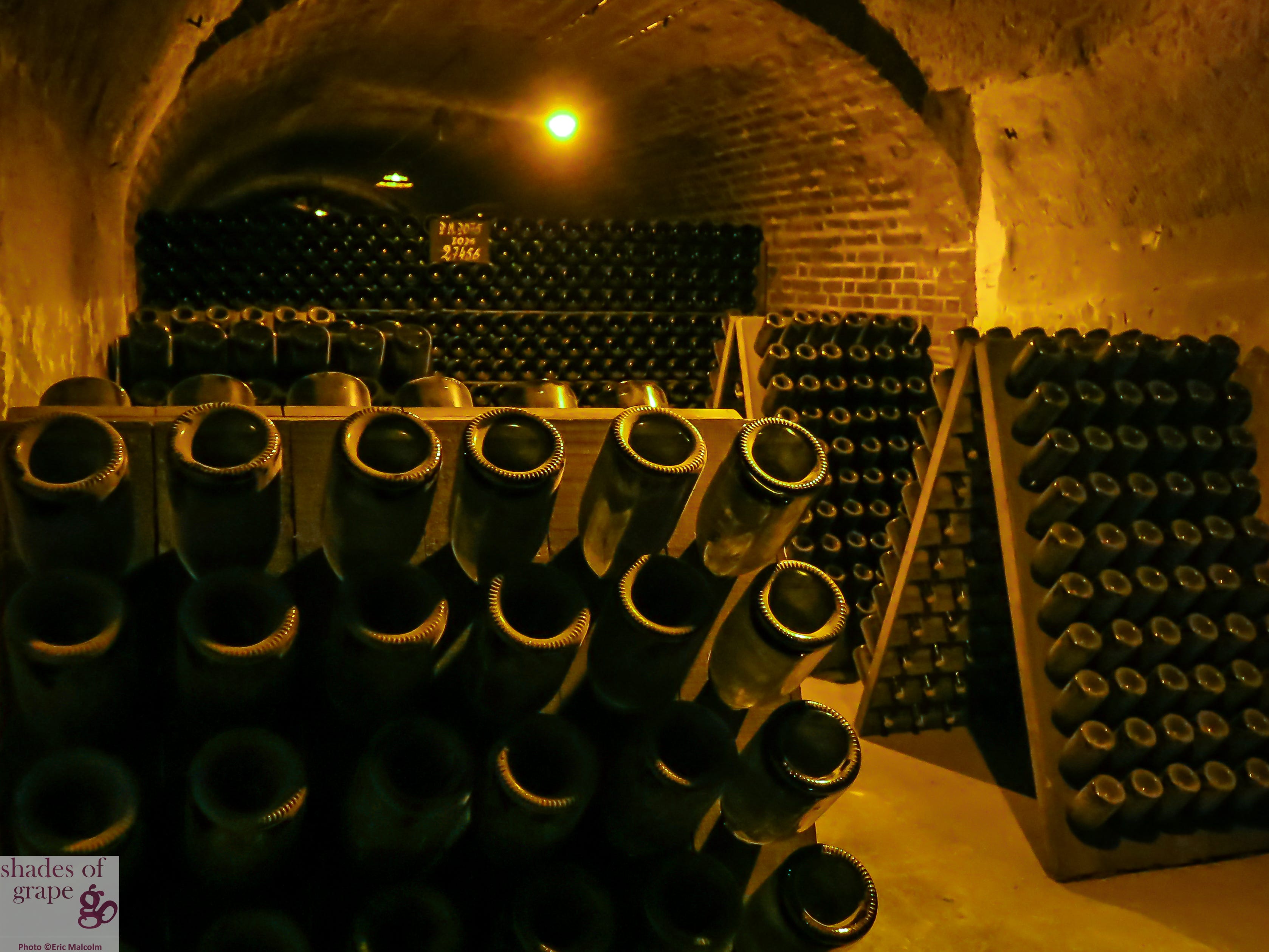
When done daily over a long period of time (typically weeks), riddling allows the yeast to accumulate in the neck of the bottle. The Veuve Clicquot house also made use of pupitres (shown in the headline photo), or riddling racks. These wooden racks have holes to accommodate multiple bottles at various angles throughout the remuage/riddling process. The Veuve Clicquot winery is said to be the only one to use the racks until 1821. Riddling racks are still in use today when traditional riddling is used. Once the spent yeast removed, the Champagne is clear!
Clearly (pun intended) this had a huge impact!
Yes!
Now more on yeast.
It plays an important part in wine, of course, but in Champagne it is doubly important as there are two fermentations involved. Firstly with the base wine, and secondly during the second fermentation which occurs in the bottle. The second fermentation’s role is purely to generate those important bubbles!
Human understanding of this organism was central to advancing Champagne to what it is today. It started in the 17th century with Antoni van Leeuwenhoek, the Dutch tradesman who first noticed yeast using high-quality lenses he developed. However, he thought they were simply starchy particles from the grain used to make whiskey and beer.
Well, awareness is the first step.
Indeed.
Eventually, in 1755 Samuel Johnson “defined” yeast as something you “...put into drink to make it work; and into bread to lighten and swell it”.
Two important things in life!
He did not understand that yeast was alive. That discovery would come later.
Jean-Antoine Chaptal (1756-1832), the French scientist and statesman, figured out that sugar turns into alcohol during fermentation. This led to the concept of adding sugar to wine to restart or strengthen fermentation.
Fun fact: he also named the element nitrogen, nitrogen.
Mega cool, dude!
You are nerdier than I am.
(technically “exactly as nerdy” because I am you)
Someone who was likely nerdier than me…
… is young French aristocrat Antoine-Laurent Lavoisier, who in 1789 discovered that sugar was converted into alcohol and carbon dioxide (CO2) during fermentation. He also evaluated the proportions of CO2 and alcohol produced for a given amount of fermenting sugar, water, and yeast.
Without CO2 there is no bubble in my Champagne!
Exactly!
Not so fun fact: He was guillotined during the French Revolution.
Likely for being a nerd.
(awkward silence)
Lavoisier’s study of proportions set up Jean-Batiste François for another discovery in 1837. This pharmacist from the Champagne region figured out the precise sugar quantity necessary to create a deliberate second fermentation in the bottle.
(You may remember from last week’s article – see link below – that during Dom Pérignon’s time the bubbles were considered a fault – and therefore - obviously not deliberate.)
In my opinion this is the most influential element in the ‘creation’ of Champagne, because without a controlled second fermentation you only have Champagne bubbles sometimes.
And I want bubbles in my Champagne … all the time!
Exactly! Consistent bubbles is the key!
But who has heard of Jean-Batiste François?
Nobody.
He published his formula just prior to his death in 1838.
But there were more milestones to come.
I mentioned riddling above. It solved one Champagne problem but created another! It was tricky to get the yeast plug out of the neck of the bottle without making a mess and losing a bunch of wine.
Because the bottle was under pressure.
Yup.
It wasn’t until 1884 that the currently used method was developed by a man called Armand Walfard. This method is called le dégorgement à la glace, or disgorgement using ice. The neck of the bottle is immersed into a very cold solution, freezing the yeast plug. Once the bottle is opened, the plug pops out in one solid chunk.
Preserving more of the pressure and sparkling wine.
And the bubbles!
Wow, now I understand how the evolution was a PROCESS!
Yes, and most methods are still in wide use except for riddling, which can be replaced with a gyropalette to quicken this process without compromising quality. This saves significant time, as the gyropalette takes only 3-4 days for a procedure that takes up to 8 weeks to complete with riddling. But some wineries still choose riddling simply because they want the cachet of being traditional.
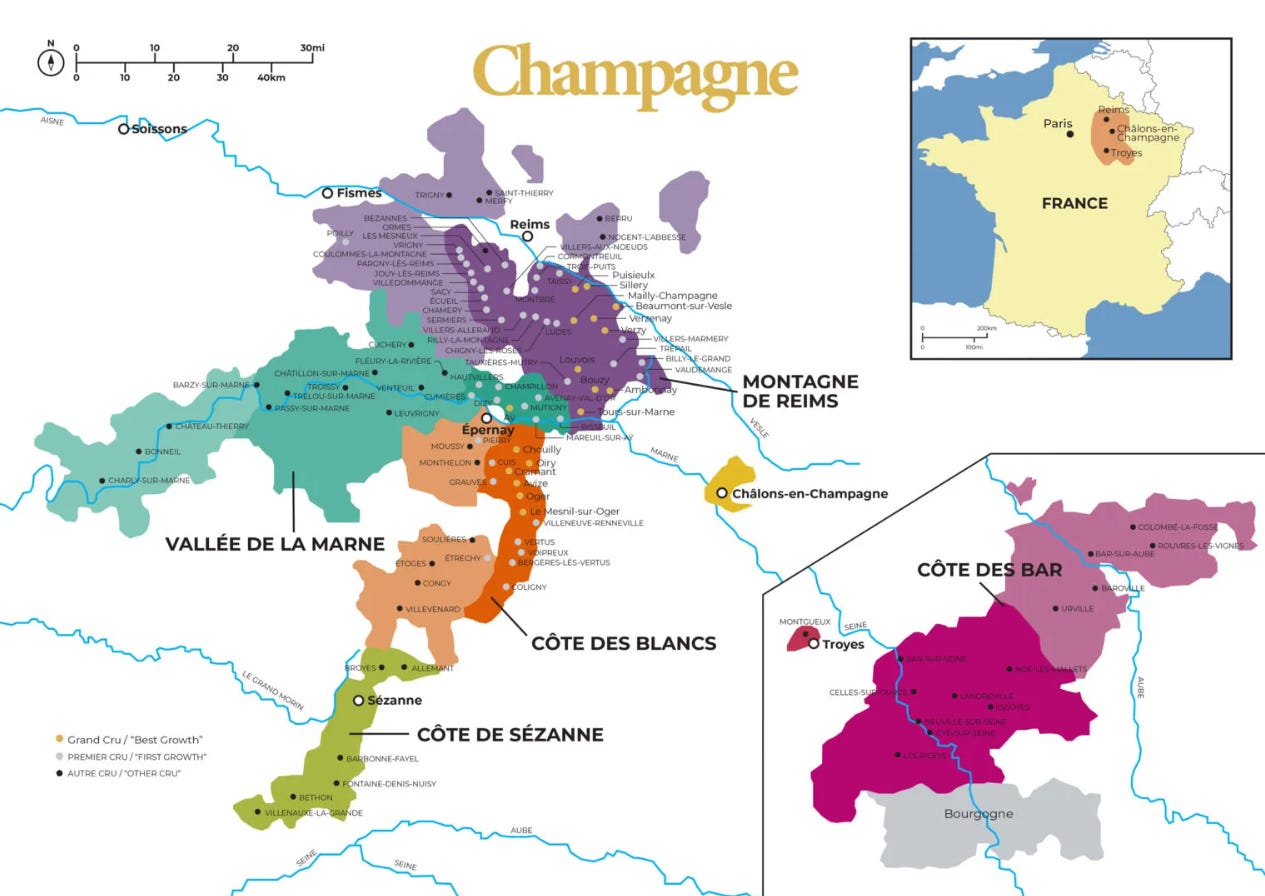
Today’s featured Champagne is what is called a grower’s Champagne. This means that the producer grows his own grapes in addition to making the Champagne. The bigger houses (Veuve Clicquot, Pol Roger, Laurent-Perrier etc.) buy most of their grapes from grape growers.
Well I feel I need a glass of Champagne now, as I feel I experienced true Champagne problems!
Chemically speaking, alcohol is a solution.
YES! I love how you justify things for me … now I got to scroll down for the rest of your goodies!
Enjoying my recommendations? Consider upgrading to a paid subscription.
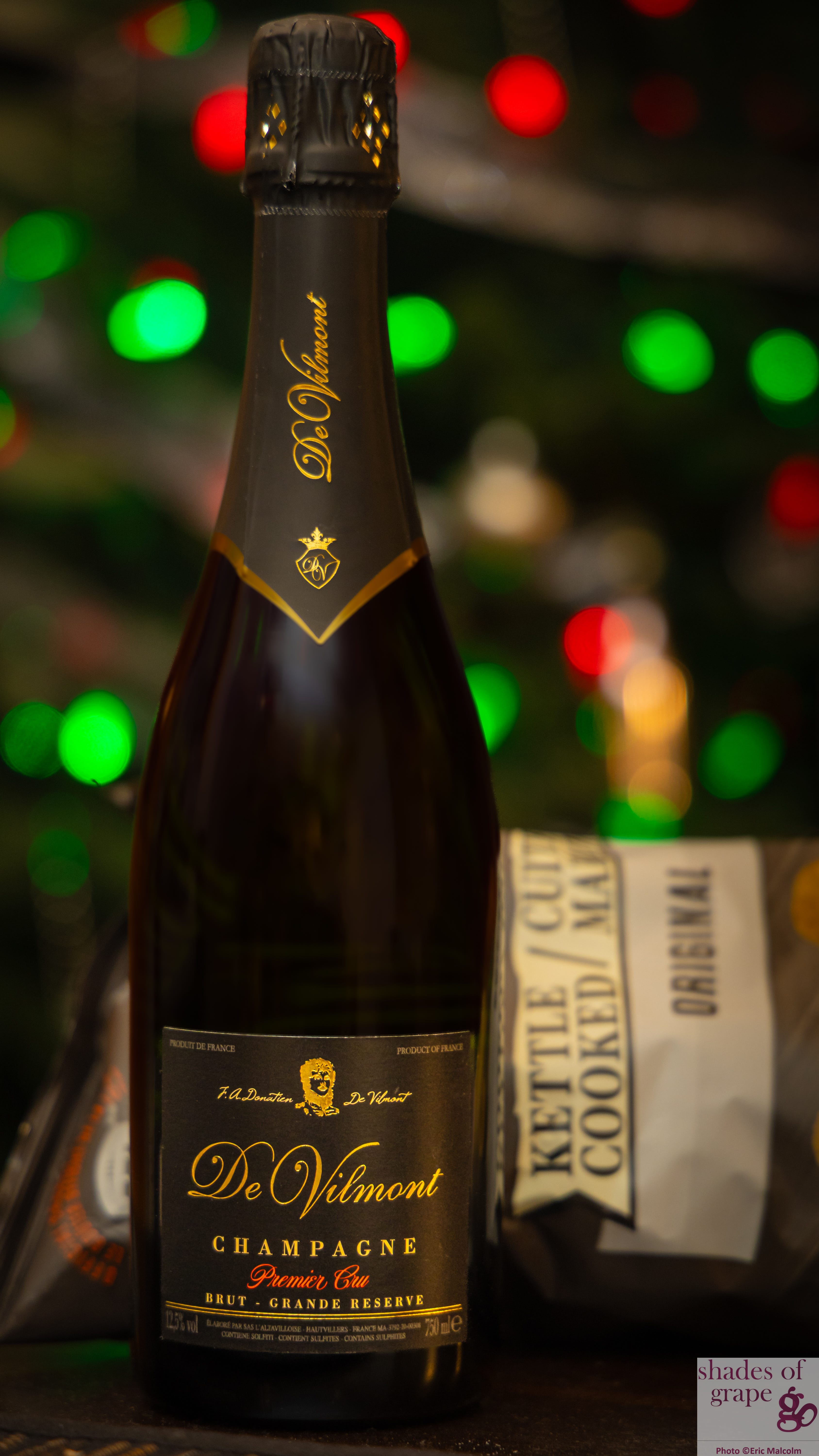
De Vilmont Brut ‘Grande Réserve’ Premier Cru NV, from Champagne, France
Style: Dry Medium Body Sparkling White Wine
Varieties: 50% Chardonnay, 25% Pinot Noir, 25% Meunier
This expressive sparkling wine has flavours of green apple, lemon, tart raspberry, unripe strawberry, biscuit/graham wafer, toast, cream, custard, and nuts with a hint of cheese. This entry-level Champagne has a delicate mousse and a persistent finish.
Best pairings: Bacon-wrapped scallops, Smoked salmon, Spicy tuna rolls, Tempura shrimp, Fried chicken, Potato chips, Popcorn, or Nuts, Cheeses: Fresh goat cheese, Brie, or Triple-cream cheeses.
Serving Temperature: 6 - 8 degrees Celsius
Serving Tips: Pop, pour & enjoy but remember the keep the bottle chilled! (to preserve the bubbles!)
Price: ~$66 Cdn
Relevant Shades of Grape links: Keep scrolling
If you're in Alberta and want a one-on-one wine curation experience, please reach out! No commitment or minimum purchase required. Interested? Please reach out!
A huge thank you to my paid subscribers—your support helps cover the costs of creating these weekly articles.
Love my wine recommendations? Enjoy my personal wine curation service? If you find value in my writing, consider upgrading to a paid subscription to help me keep sharing the world of wine with you!
Subscribers receive 15% off Wine & Spirits whenever shopping at Cork Fine Wines, ground floor, Bow Valley Square in Calgary.
LINKS TO RELEVANT PAST SHADES OF GRAPE ARTICLES:


SOURCES:
Champagne.fr, no date. Champagne and its history. [online] Available at: https://www.champagne.fr/en/about-champagne/champagne-and-its-history [Accessed 18 December 2025].
Champagne.fr, no date a. L’histoire du Champagne. [online] Available at: https://www.champagne.fr/fr/decouvrir-le-champagne/histoire-du-champagne?utm_source=chatgpt.com#origines [Accessed 18 December 2025].
Dom Pérignon: Fact & fiction, 2019. [online] Available at: https://www.guildsomm.com/public_content/features/articles/b/tom_stevenson/posts/dom-perignon?utm_source=chatgpt.com [Accessed 18 December 2025].
Encyclopaedia Britannica, 2025. Antoine Lavoisier. [online] Available at: https://www.britannica.com/biography/Antoine-Lavoisier [Accessed 18 December 2025].
Encyclopaedia Britannica, 2025. The chemical revolution. [online] Available at: https://www.britannica.com/science/chemistry/The-chemical-revolution [Accessed 18 December 2025].
Encyclopaedia Britannica, 2025. The French Revolution and Lavoisier’s execution. [online] Available at: https://www.britannica.com/biography/Antoine-Lavoisier/The-French-Revolution-and-Lavoisiers-execution [Accessed 18 December 2025].
Encyclopædia Universalis, 2025. Fermentations – repères chronologiques. [online] Available at: https://www.universalis.fr/encyclopedie/fermentations-reperes-chronologiques/ [Accessed 18 December 2025].
GmbH, W., 2023. Antoine de Muller. [online] Available at: https://glossary.wein.plus/antoine-de-muller-2?utm_source=chatgpt.com [Accessed 18 December 2025].
Harding, J. and Robinson, J., 2023. The Oxford companion to wine. Oxford: Oxford University Press.
Jean-Antoine Chaptal, no date. [online] Available at: https://en-academic.com/dic.nsf/enwiki/265276?utm_source=chatgpt.com [Accessed 18 December 2025].
MAZLIAK, P., no date. FERMENTATIONS - repères chronologiques. [online] Available at: https://www.universalis.fr/encyclopedie/fermentations-reperes-chronologiques/?utm_source=chatgpt.com [Accessed 18 December 2025].
National Geographic, no date. Champagne. [online] Available at: https://www.nationalgeographic.com/search?q=champagne&location=inline&type=manual&typedTerm=champagne [Accessed 18 December 2025].
Oxford Reference, 2025. Jean Antoine Claude Chaptal. [online] Oxford University Press. Available at: https://www.oxfordreference.com/display/10.1093/oi/authority.20110803095602732 [Accessed 18 December 2025].
Robinson, J., 2003. Vines, grapes & wines: The wine drinker’s guide to grape varieties. London: McArthur & Co. Publishing.
Sanderson, & Thomas, R., 2025. Nitrogen | Definition, Symbol, Uses, Properties, Atomic Number, & Facts. Encyclopaedia Britannica. [online] Available at: https://www.britannica.com/science/nitrogen [Accessed 18 December 2025].
The birthplace of Champagne, no date. [online] Available at: https://www.champagne-patrimoinemondial.org/en/decouvrir/birthplace-champagne?utm_source=chatgpt.com [Accessed 18 December 2025].
wein.plus, 2025. Veuve Clicquot‑Ponsardin. [online] Available at: https://glossary.wein.plus/veuve-clicquot-ponsardin [Accessed 18 December 2025].
Wine & Spirit Education Trust, 2025. D3: Wines of the World - An accompaniment to the WSET Level 4 Diploma in Wines. Version 1.2. London: Wine & Spirit Education Trust.
Yeast, fermentation, beer, wine | Learn Science at Scitable, no date. [online] Available at: https://www.nature.com/scitable/topicpage/yeast-fermentation-and-the-making-of-beer-14372813/ [Accessed 18 December 2025].